
 By
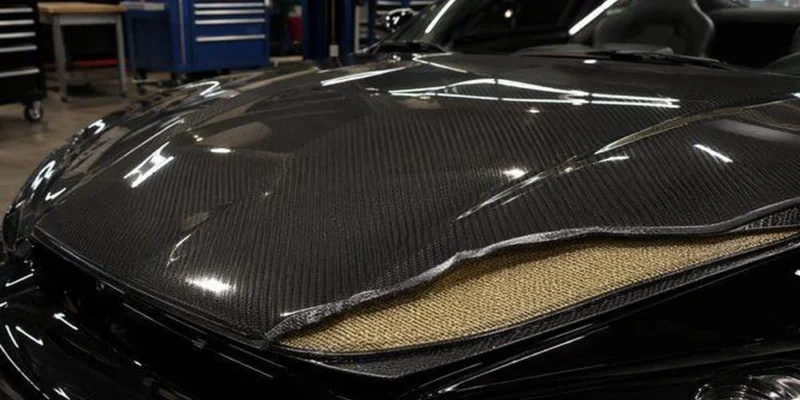
Different parts, different enemies. The material map of a car.
Nobody buys ‘a material for the car.’ You buy a hood, a splitter, a set of mirror caps. And each of those parts lives in a different neighborhood with different crime statistics. Here is a part-by-part tour of the car, with the material that actually makes sense in each spot and why.
Hood: Carbon, Full Stop
A hood is a huge, flat panel that must not flex, flutter, or oil-can at speed. Stiffness is everything, impact exposure is nearly zero, and weight savings over the front axle are the most valuable grams on the car. This is carbon fiber’s best argument on the entire vehicle. Kevlar adds nothing here except cost.
Front Splitter and Lip: Hybrid Territory
The splitter leads the car through the world and collects everything the world throws back: curbs, steep ramps, gravel, tire marbles on track. It also works as an aero surface, so it cannot be floppy. Pure carbon is stiff enough but cracks on the first real hit. Pure Kevlar survives hits but flexes too much for aero work. The hybrid weave, carbon for shape, aramid for survival, exists for exactly this part. The carbon Kevlar vs carbon fiber comparison shows the impact-behavior gap that drives this choice.
Bumpers: It Depends on the Car’s Life
Show car that trails between events? Carbon, and enjoy the weave. Street car that parallel parks? Hybrid on the lower lip at minimum. Rally car that eats rocks for a living? Aramid-heavy layups in the strike zones, and inspect them after every event. The bumper is the part where honesty about how you drive pays the most money.
Rocker Panels and Side Skirts
Rocker panels sit in the gravel blast zone behind the front wheels. Every stone the front tire throws ends up here. They are also visible at eye level when the door opens, so looks matter. Hybrid weave covers both requirements. This is quietly one of its best applications.
Rear Wing and Spoiler: Carbon Again
A wing is a pure aero device. It lives two meters off the ground where nothing hits it, and it must hold its angle of attack precisely under load. Carbon fiber, no debate. Spend the hybrid budget elsewhere.
Mirror Caps, Interior Trim, Engine Covers
Small, safe, visible. These parts are where weave choice is pure style. Twill, forged, or hybrid gold all work mechanically. Pick with your eyes. If you want to browse what is possible on the visual side, the carbon fiber color guide maps out the real options, and forged carbon fiber is worth a look for a completely different texture. One tip: order these pieces together with your bigger parts so the weave direction and gloss level match across the car. Nothing betrays a piecemeal build faster than three shades of ‘the same’ carbon.
Undertray: Aramid’s Home Game
An undertray on a lowered car or a gravel-event car takes constant strikes and never gets seen. Stiffness matters little, looks matter not at all, impact survival matters entirely. This is the one place a Kevlar-heavy layup beats even the hybrid.
Roof, Trunk, and Diffuser
Three more parts round out the map. Roof skins and trunk lids behave like hoods: large panels, minimal impact, stiffness and weight savings on top of the car where grams count double, carbon, always. A rear diffuser is trickier: it sits low, in the debris stream off the rear tires, and it clips the occasional steep driveway exit. On a street car the hybrid weave is cheap insurance here; on a trailer-kept show car, save the money and go carbon. As always, the zip code of the part decides.
Interior and Engine Bay Pieces
Inside the cabin, nothing gets struck by gravel and nothing carries aero load, so the material question collapses into a style question. Trim panels, shift surrounds, and seat backs can be anything that makes you happy, twill, hybrid gold, or forged. The one mechanical note: seat backs and steering-adjacent trim should come from a maker who understands UV and heat cycles, because cabin temperatures in a parked car surprise people. Under the hood, engine covers need heat tolerance more than toughness, so ask about the resin’s service temperature rather than the weave.
The Pattern
If you want the whole philosophy in one line: carbon on top, hybrid down low, aramid underneath, and your eyes on the style pieces. Tape that to the garage wall and you will not go far wrong.
Read back through the list and the pattern is obvious: the higher and cleaner a part lives, the more carbon makes sense; the lower and dirtier, the more aramid belongs in the weave. Your car is not one material decision. It is about eight of them. Make those eight decisions one at a time, and the car will thank you every time the road gets rough.








Comments